

Playing Eyes: Understanding the Communicative Power of Gaze Expressions when Bluffing and Being Confident in Winning
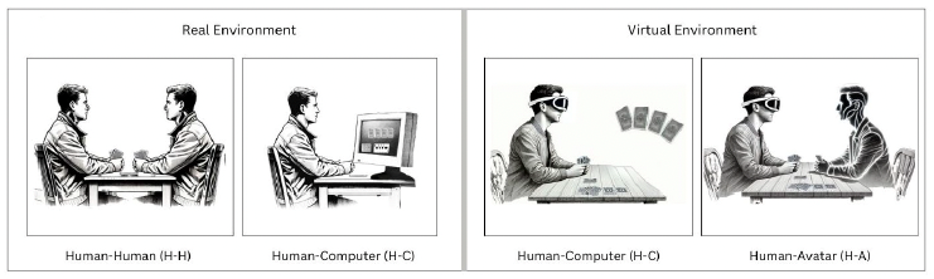
The widely held belief that “the eyes never lie” suggests that gaze is one of the so-called honest signals revealing a person’s true intentions and emotions. However, people highly value their privacy and often try to disclose not more than intended. We have, however, a limited understanding of which gaze measures (e.g., fixation rate, blink frequency, and pupil motion) express such internal states and how other persons perceive those in interactions. In existing research, gaze measures are often researched in isolation and in controlled non-social settings, limiting their applicability to dynamic social interactions. Therefore, we will examine gaze expressions and their perception in social settings. Card games are chosen as the experimental setting since they provide a controlled yet dynamic environment where players strategically manage their gaze to influence others. Studying gaze measures in social card game interactions ensures ecological validity. Games provide the opportunity for parallel investigation in authentic social interactions in real environments (Prof. Huckauf) and simulated virtual environments (Prof. Rukzio). Virtual environments have the advantage of allowing very precise manipulation of gaze measures in a virtual avatar, which is not feasible in real environments. This provides a unique testbed for exploring gaze expression in a very controlled way to replicate our findings from the studies in real environments and validate our assumptions. Furthermore, the virtual environment allows the investigation of human players’ perceptions of the gaze expressions of virtual avatars. These expressions can manipulate the player’s strategy and playing behavior. It is, therefore, our goal, with Objective 1, to measure and quantify players’ gaze expressions during bluffing, not bluffing, and low or high confidence in winning during card games. Building on this, Objective 2 focuses on determining whether these gaze expressions are produced and interpreted as meaningful communicative signals. Finally, Objective 3 seeks to explore how players’ gaze expressions during strategic moments, such as bluffing and confidence, can predict game outcomes and player reactions, as well as how an avatar’s gaze expression can manipulate players’ behavior. Ultimately, the project will extend our understanding of the human gaze by providing a framework for understanding how gaze expressions communicate complex cognitive-affective states of bluffing and confidence in winning and how gaze expressions are perceived and interpreted during real-time interaction in real and virtual environments. This knowledge could support the development of technology capable of interpreting such human emotions and intentions more accurately in digital environments, contributing to the creation of more sophisticated virtual agents that adapt to users’ mental states enhancing digital communication, collaboration, and therapeutic interventions.
Deutsche Forschungsgemeinschaft (DFG) - Project number 563076722

Prof. Dr. Anke Huckauf
Experimental Psychology, Institute of Psychology and Education, Faculty of Engineering, Computer Science, and Psychology, Ulm University
Prof. Dr. Anke Huckauf has published more than 100 research articles on basic perception as well as on applied topics of eye input and gaze-based interaction. She has organized several international and national events, and has served as member of editorial boards. Anke Huckauf studied psychology at universities of Frankfurt/Main, Mainz, and RWTH Aachen, where she also received her PhD. She headed a Juniorprofessorship at the faculty Media, Bauhaus-University in Weimar. Since 2009, she holds a full professorship for General Psychology at Ulm University, Germany. Her main research interests are on perception out of focus and gaze-based interaction.

Prof. Dr. Enrico Rukzio
Human-Computer Interaction group, Institute of Media Informatics, Faculty of Engineering, Computer Science, and Psychology, Ulm University
Prof. Dr. Enrico Rukzio studied computer science at TU Dresden and received his doctorate from LMU Munich in 2007. After holding academic positions at TU Dresden and LMU, he was a lecturer at Lancaster University from 2013 to 2016 and an assistant professor at the University of Duisburg-Essen from 2010 to 2012. Since 2012, he has been Professor of Human-Computer Interaction at the University of Ulm, where he heads the Human-Computer Interaction Group and the Institute for Media Research and Media Development. His research focuses on interactive and everyday technologies, including gaze-based interfaces, extended and mixed reality, automotive interfaces and digital health applications. He also serves on academic boards and programme committees of international HCI conferences.
Team members
Garanfil Hasanzade
Experimental Psychology, Faculty of Engineering, Computer Science, and Psychology, Ulm University
Garanfil Hasanzade is a PhD candidate in Experimental Psychology at Ulm University. She holds a BA in Psychology from Khazar University and an MSc in Cognitive Science from Nicolaus Copernicus University in Toruń, Poland. Her previous work includes projects on mental rotation and tactile-guided grasping, reflecting broader research interests in spatial cognition, social cognition, and human - computer interaction.
Within the Playing Eyes project at Ulm University, she investigates social gaze interaction when bluffing and being confident in winning during playing games in human-human and human-comupter scenarios.

Richard Reiber
Human-Computer Interaction group, Institute of Media Informatics, Faculty of Engineering, Computer Science, and Psychology, Ulm University
Richard Reiber will start his PhD in Autumn 2026 working in the project Playing Eyes together with Enrico Rukzio and Tobias Wagner in the Human-Computer Interaction group at Ulm University.

Tobias Wagner
Human-Computer Interaction group, Institute of Media Informatics, Faculty of Engineering, Computer Science, and Psychology, Ulm University
In 2019, after Tobias Wagner graduated from Ulm University with a Bachelor's degree in Media Informatics with a thesis titled "Adaptive AR Interfaces Via EEG", he joined the Human-Computer Interaction research group as a research assistant. While completing his Master's degree in Media Informatics at Ulm University, he worked on several research projects in personal fabrication and gaze-based interaction in teaching. With his Master's thesis titled "Effects of Attention Guiding in Lecture Videos via Implicit and Explicit-Based Visual Pointers" Tobias completed his Master's degree in September 2022.
Currently, Tobias is PhD at the Institute of Media Informatics at Ulm University, researching technology-enhanced teaching and learning using gaze-based interactive systems. He is a Co-Supervisor for the Playing Eyes project.