

Mutual eye contact and blink synchronization as predictors for successful cooperation
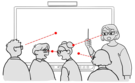
The planned project investigates the role of mutual eye-contact and blink synchronization in fostering interpersonal trust, cooperation, and problem-solving ability. Building on the Priority Program “Understanding Gaze (UGaze),” this research aligns with Topic (II) Gaze Sharing, exploring how gaze dynamics influence behavioral outcomes in social and collaborative settings. Leveraging dual mobile eye-tracking technology, we aim to capture real-time gaze interactions and their impact on trust and decision-making in an economic trust game, as well as problem-solving efficacy in the hidden profile paradigm. In the first study, we examine the effects of mutual eye-contact and blink synchronization on interpersonal trust and cooperative behavior during face-to-face economic trust games. Research questions focus on the extent to which gaze dynamics influence trust-building and the relationship between eye-contact and blink synchronization. The second study extends this exploration to collaborative problem-solving scenarios, investigating how shared attention, mediated by eye-contact and blink synchronization, contributes to problem-solving performance. We further examine the interplay between shared information and gaze synchronization, hypothesizing that higher synchronization enhances collective cognitive processes. This project bridges key gaps in understanding gaze as a dual-function tool—both perceptual and social—providing insights into the mechanisms of synchronization in cooperative and problem-solving contexts. By advancing methodologies with dual mobile eye-tracking, our findings will offer theoretical and practical implications for enhancing collaboration in educational, organizational, and technological environments.
Deutsche Forschungsgemeinschaft (DFG) - Project number 563079426

Dr. Alexandra Hoffmann
Department of Psychology, General & Cognitive Psychology, University of Innsbruck
Dr. Alexandra Hoffmann is a postdoctoral researcher at the Department of Psychology at the University of Innsbruck. She studied psychology at the University of Innsbruck and completed her PhD at UMIT Tirol, where she researched the psychophysiological basis of cognitive impairments in major depression. After completing her doctorate, she shifted her focus more towards general psychology and has since been working extensively with eye-tracking and psychophysiological methods. Her current research investigates gaze behaviour in social contexts, in particular using mobile eye-tracking in natural interactions. She is dedicated to better understanding the mechanisms of social attention, perception and mutual coordination.
Team members

Dr. Thomas Maran
Department of business and economics, Free University of Bolzano
Dr. Thomas Maran is a management researcher at the Faculty of Economics at the Free University of Bozen-Bolzano. He conducts research on leadership, strategy and entrepreneurship, and previously worked at the Universities of Innsbruck, Liechtenstein and Klagenfurt. His work has been published in international journals such as The Leadership Quarterly, Technological Forecasting and Social Change and the Journal of Business Research. He teaches in various study programmes and executive education formats in Italy, Austria and Switzerland. He is also involved in numerous transfer and cooperation projects with companies and public organisations. In addition, he advises organisations on leadership, strategy and innovation. He is the author of the book Situativ führen.

Jonas Milis
Jonas Milis is now a doctoral researcher in this project. He completed his bachelor’s degree in psychology at Hochschule Fresenius and earned his psychology master’s degree from the University of Heidelberg. In his master’s thesis, he examined inadmissible evidence bias as a cognitive mechanism and its influence on mock juror decision-making. His broader research interests center on socio-cognitive processes in group settings, with the aim of better understanding how information processing, cognition, and social dynamics unfold in real-world situations.