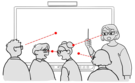


How do primates interpret and respond to others' intentions by observing their gazes?
Primates rely heavily on visual cues, such as gaze, head, and bodily expressions, to engage in social interactions and infer the intentions of others. This ability enables proactive decision-making in dynamic environments, allowing individuals to anticipate actions rather than simply react. Here, we seek to address key gaps in our understanding of the role of gaze-based communication in value-based decision-making in primates, specifically rhesus macaques, red-fronted Lemurs, and humans, using naturalistic, interactive scenarios. By studying macaques in controlled interactive settings, we will also investigate the roles of the parietal and prefrontal cortices in inferring and acting upon others' intentions. Experiments will involve tracking head, eye, and body movements during tasks where individuals must balance observing others’ gaze with competing demands of a behavioral task. Additionally, we will develop a predictive computational model using gated recurrent neural networks (GRUs) to analyze how gaze cues and social dynamics influence decision-making. This model will also serve as a tool to strengthen collaboration within UGaze, extending its application to other contexts, such as joint attention and gaze dynamics in human interactions. By bridging species and integrating advanced methodologies, we will contribute to UGaze’s goal of understanding the role of complex gaze patterns in social behavior.
Deutsche Forschungsgemeinschaft (DFG) - Project number 563110410

Dr. Neda Shahidi
Head of the Early Career Research Group „Embodied Cognition“, University of Göttingen
Dr. Neda Shahidi studied Electrical and Computer Engineering at the University of Tehran from 1999 to 2004 and at the University of Texas at Austin from 2007 to 2010. From 2011 to 2018, she was a doctoral student and graduate research assistant at the University of Texas Health Science Centre at Houston, where she obtained her PhD in neuroscience in 2018. Since 2018, she has been conducting research at the University Medical Centre Göttingen, between 2020 and 2023, she was also a postdoctoral researcher at the German Primate Centre. Since 2023, she has been leading the Early Career Research Group ‘Embodied Cognition’ in SFB 1528 ‘Cognition of Interaction’ at the University of Göttingen in cooperation with the German Primate Centre. Her research investigates the neural basis of ecologically relevant decisions and the relationships between bodily states and decision-making processes. In addition, she has been involved in science communication for many years, including as a lecturer in the brainSTEM programme at various US universities.
Team members

Piyali Chandra
Piyali Chandra holds an M.Tech in Information Technology from Jadavpur University and a B.Tech in Computer Science from the West Bengal University of Technology in India. After completing her master’s degree, she gained 2 years of project-internship experience. Subsequently, she served as an Assistant Professor at the University of Engineering and Management for over 3 years, where she taught core computer science subjects, mentored students, and contributed to multiple research projects. As a Research Assistant at the Institute for Medical Informatics at the University of Göttingen, Germany, she contributed to a collaborative cardiovascular risk assessment project by developing data pipelines, preparing and structuring patient datasets, and implementing predictive models to identify key risk factors. Her research interests include augmented reality, image segmentation, and predictive modeling. She has been recognized for her contributions to teaching and mentorship and has served as a reviewer for multiple academic conferences. In addition to research and teaching, she has actively organized conferences, workshops, and student competitions.