

AEyeCoL: Advanced Understanding of Eye Gaze in Co-Located Collaborative Learning
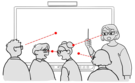
Collaborative learning (CL) is a key component of 21st-century education, recognized for its potential to foster critical thinking, problem-solving, and lifelong learning skills. Whereas extensive research has examined the effects of CL on learning outcomes, much less is known about the non-verbal mechanisms that underpin successful collaboration. This project aims to advance our understanding of gaze dynamics in co-located, small-group CL settings using mobile eye-tracking technology and machine learning (ML) techniques. By analyzing gaze interactions such as joint visual attention (JVA), JVA initialization, and eye contact, we aim to uncover the social and cognitive processes that drive effective collaboration. The proposed project has five main objectives: (O1) To assess a comprehensive set of group-level gaze indicators relevant to CL. (O2) To develop an automated gaze analysis pipeline using computer vision methods, replacing manual annotation of areas of interest to extract gaze indicators and publish it as an open-source resource. (O3) To publish an anonymized large-scale eye-tracking dataset for future collaboration research. (O4) To predict team dynamics, such as leadership emergence and turn-taking, using ML models based on gaze indicators. (O5) To transfer and adapt our methods to real-world educational settings with school-aged children, shedding light on the interplay between gaze dynamics, group processes, and learning outcomes. Through two cascading CL studies, the first one investigating university students, and the second one elementary school children, we will address critical gaps in the field, including the lack of comprehensive gaze indicators beyond JVA, the scarcity of tools for scalable analysis, and the limited focus on naturalistic and multi-user settings in existing research. By investigating how gaze behaviors reflect team dynamics and their relationship with instructional quality and learning outcomes, this project will offer new insights into the processes underlying effective collaboration. The results will lead to the publication of a rich, anonymized mobile eye-tracking dataset, an open-source framework for gaze analysis, and actionable design guidelines for enhancing CL in both higher education and school contexts. These contributions will not only advance research on gaze dynamics but also inform the design of AI-driven tools and instructional methods to improve collaboration and learning outcomes in diverse educational and professional settings. Furthermore, our interdisciplinary approach, integrating research on education and computer science, aligns with UGaze by advancing the understanding of gaze dynamics in collaborative interactions, bridging Gaze Sharing and Gaze-Based Interaction through the development of scalable tools and an open-source dataset, fostering community-driven research and enabling applications across educational and diverse multi-user contexts.
Deutsche Forschungsgemeinschaft (DFG) - Project number 563097140

Dr. Babette Bühler
Human-Centered Technologies for Learning, Technical University of Munich
Dr. Babette Bühler is a postdoctoral researcher at the Chair of Human-Centred Technologies for Learning at the Technical University of Munich. She completed her PhD in computer science at the University of Tübingen, where she conducted research at the Hector Research Institute of Education Sciences and Psychology and the LEAD Graduate School & Research Network. Prior to that, she completed a master's degree in data science and a bachelor's degree in sociology at the University of Mannheim.Her research focuses on the intersection of artificial intelligence and educational research. She is involved in the development of multimodal models that integrate eye tracking, video, physiological signals and text data to capture attention, mind-wandering and interaction dynamics in learning. A research stay at the Emotive Computing Lab at the University of Colorado Boulder deepened her work on the generalisability of video-based attention models.

Dr. Tim Fütterer
Hector Research Institute of Education Sciences and Psychology, University of Tübingen
Dr. Tim Fütterer has been a postdoctoral researcher at the Hector Institute for Empirical Educational Research at the University of Tübingen since 2018. He studied to become. teacher of mathematics and economics/politics at Christian Albrecht University in Kiel, where he also obtained his doctorate in empirical educational research. His research focuses on AI-based methods for analysing multimodal teaching data, adaptive teacher training, and digitally supported teaching quality. He also investigates the interaction between artificial intelligence and self-regulation in the learning process. He is involved in several third-party funded projects and is a member of numerous professional networks. Research stays have taken him to the Centre for Educational Measurement at the University of Oslo and the Graduate School of Education at Stanford University, among others.
Dr. Enkelejda Kasneci
Human-Centered Technologies for Learning, TUM School of Social Sciences and Technology, Technical University of Munich
Prof. Dr. Enkelejda Kasneci is a Distinguished Professor (Liesel Beckmann Distinguished Professor) of Human-Centered Technologies for Learning and Director of the TUM Center for Educational Technologies. She received her MSc in computer science from the University of Stuttgart and her PhD in computer science from the University of Tübingen in 2013. Afterwards, she was a Margarete von Wrangell Fellow (2013-2015), assistant professor of Perception Engineering (2015-2019), and professor of Human-Computer Interaction (2019-2022) at the University of Tübingen. Her research evolves around human-centered technologies, emphasizing the crossroads between multimodal interaction and cutting-edge technological tools, such as VR, AR, and eye-tracking methodologies. Her research incorporates artificial intelligence to foster and facilitate the emergence of innovative learning paradigms. By investigating these interdisciplinary areas, Prof. Kasneci aims to enhance educational experiences and promote a more profound understanding of the intricate interplay between humans and technology.
Dr. Ulrich Trautwein
Hector Research Institute of Education Sciences and Psychology, University of Tübingen
Prof. Dr. Ulrich Trautwein is Professor of Empirical Educational Research at the University of Tübingen, Managing Director of the Hector Research Institute of Education Sciences and Psychology, and Co-Director of the LEAD Graduate School & Research Network. After holding academic positions at the Max Planck Institute for Human Development, he took up the chair in Tübingen in 2008. His research investigates learning and performance development, in particular motivation, self-regulation, teaching quality, digital learning settings, and gifted education. Methodologically, he works with large-scale field studies and increasingly uses AI-based approaches to analyse learning processes. Trautwein is a member of several scientific advisory boards and has been chairman of the Scientific Advisory Board of the Baden-Württemberg Ministry of Education and Cultural Affairs since 2017. He has been awarded the Otto Hahn Medal, the CORECHED Prize and the DGP Young Scientist Award, among others, for his achievements. In 2024, he was honoured as an AERA Fellow.
Team members
Luise Mehner
Luise Mehner is a PhD student at the Hector Research Institute of Education Sciences and Psychology, University of Tübingen and a member of the LEAD Graduate School & Research Network. She started her PhD in July 2025 after completing a bachelor's degree in digital media and technology, a bachelor's degree in psychology, and a master's degree in computer science. In her research, she studies collaborative problem-solving in small groups. In particular, she investigates gender differences in collaborative problem-solving, and how the equitable development of collaborative problem-solving skills can be supported in co-located learning environments.