

Priority Programme "Understanding Gaze (UGaze)" (SPP 2481)
Aims and Scope
Eyes, metaphorically the windows to our souls, have been a subject of eye tracking research in the last century. This research has successfully identified and isolated various gaze measures (e.g. fixations, saccades, pupil-related features, visual scanpaths) pivotal for perceptual and cognitive processing. As these results are frequently isolated and examined in specialised laboratory tasks, the next step is to approach the bigger picture in which both the measures and the tasks are combined and contextualised. Humans do not only move their eyes, they also observe others moving their eyes. Specific eye movements and movement sequences have meanings, such as attending or ignoring, or direct, averted, or mutual gaze. Hence, eye movements are instrumental and communicative in interactions and collaborative tasks.
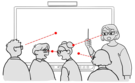
The Priority Programme UGaze aims to investigate the role of gaze in conveying information about the dynamics and specifics of (preferably natural) tasks in order to understand how gaze patterns are interpreted by others during interactive and collaborative tasks, and to explore the use of gaze in multi-user scenarios, by fostering research within three key development areas:
(I) Gaze Expression: Understanding the information gained from gaze, with particular focus on how gaze measures are interpreted by those observed, requires eye tracking research with a view to the meanings attributed to gaze, exemplified by questions such as:
- How are particular gazes interpreted, what are the roles of gaze direction, eye shape, emotion, perspective, illumination, distance, etc. on the perception of direct gaze and object-directed gaze? What are influencing factors of the person observing, how is gaze perception expressed in eye movements?
- (How) can we detect intention, e.g. joking, lying, etc. by gaze behaviour? Is there a gaze pattern of surprise, puzzlement and distraction, which is generally understandable? What is the time course and what are the consequences of various gaze expressions for attention and perception?
(II) Gaze Sharing: Various gaze interactions, including joint viewing and mutual gaze, have mechanisms and effects that still remain unclear. Analysing these interactions is crucial for comprehending the signalling and the perceptual functions of gaze, for example:
- Categories of Gaze and their Relation: How frequently do we experience mutual eye contact; what are conditions, dynamics and effects? What are the similarities and differences between direct mutual gaze, referential gaze and averted gaze?
- How is joint attention and joint fixation established, how does it develop, what are determinants for sustaining joint attention? Is there a dominating person, how is dominance reflected in gaze behaviour?
(III) Gaze Interaction in Multi-User Scenarios: Using gaze can enhance new interaction technologies. In many settings, such as public displays or video conferencing tools, gaze-based interfaces can enable fast and remote interaction, for example via enriching video conferencing by showing your viewpoints. Exemplary research questions can be:
- What techniques can be developed to integrate the perception-action loop underlying individual gaze behaviour with the dynamics of the interactive gaze circuit, considering factors such as fixation selection, foveal positioning, field of view, blink rates and durations, the role of pupil adjustments, etc. in information intake?
- How can advancements in hardware miniaturisation and machine learning algorithms be leveraged to study natural gaze behaviour in diverse contexts, particularly in scenarios involving multiple participants or objects, and how can the complex interplay of gazes with objects and other gazes be analysed and understood?
- Privacy: With eye-tracking technology becoming more integrated into everyday devices and applications, privacy issues have become paramount. While offering a deep dive into cognition and behaviour, gaze can also inadvertently reveal sensitive and personal information about an individual. As we capture, analyse and interpret gaze data, ensuring the protection of individual privacy is essential. We hence encourage research on privacy in eye tracking in the context of this proposal.
Through UGaze, we intend to support investigators through winter schools, hybrid seminars, friendly and open collaboration, gender equality awareness and a family-friendly policy.